


Term Insurance:
Term insurance is one of the simplest and most important forms of life-insurance protection. Its primary purpose is to provide financial security to a policyholder’s family if the insured person dies during the policy term, subject to the policy’s terms and conditions.
For individuals who have dependents, outstanding loans, children’s education responsibilities, or other long-term financial commitments, adequate term insurance can provide an important financial safety net.
Unlike many traditional life-insurance products, a pure term-insurance policy is primarily focused on protection rather than savings or investment returns. This makes it particularly relevant when the objective is to secure a substantial amount of life cover at a comparatively affordable premium.
This guide explains the importance of term insurance, its major types, important features, factors affecting premiums, and how to evaluate a policy.
What Is Term Insurance?
Term insurance is a life-insurance policy that provides coverage for a specified period, known as the policy term.
- If the insured person dies during the policy term, the applicable death benefit is paid to the nominee, subject to the policy conditions.
- If the insured person survives the term, the outcome depends on the type of term policy.
- A standard pure-term policy generally does not provide a maturity benefit unless specifically structured otherwise.
The fundamental purpose of term insurance is therefore: Income Protection + Family Protection + Liability Protection
It is not primarily designed to generate investment returns.
Term Insurance: Importance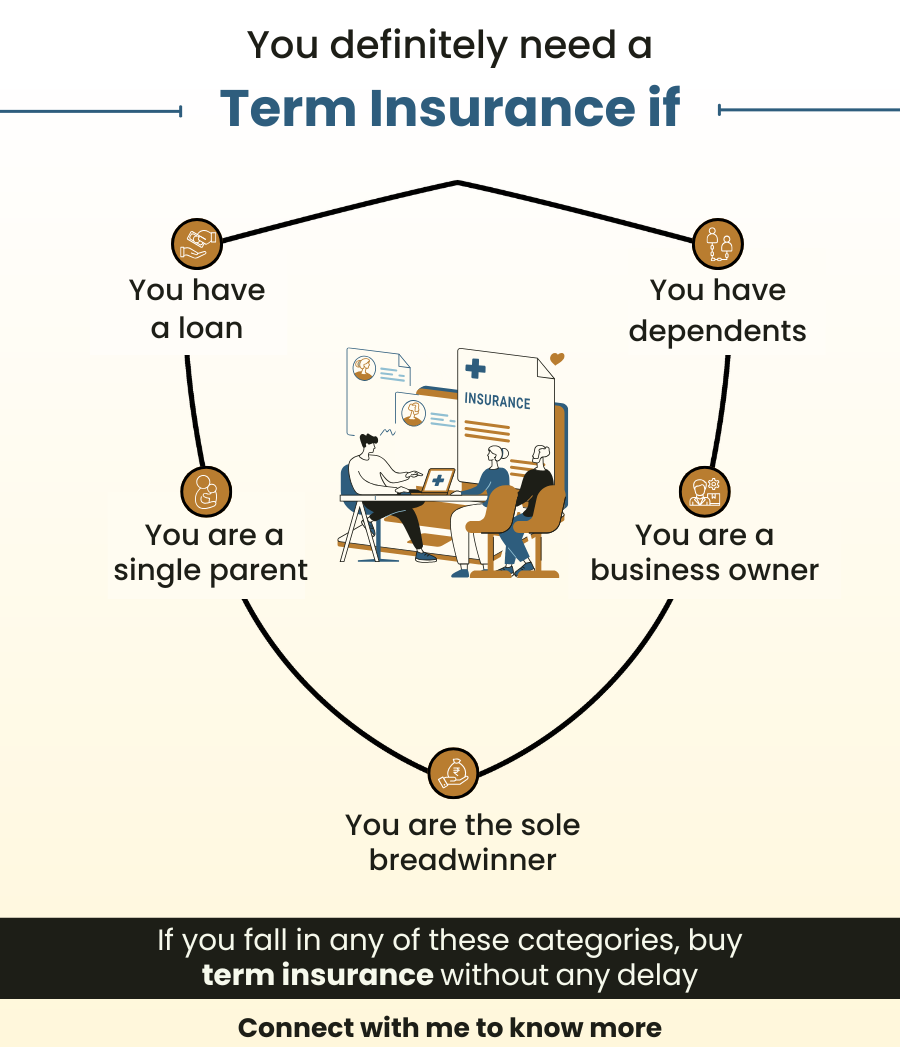
1. Protecting Family Income
For many families, the income of one or more earning members supports household expenses. If an earning member dies prematurely, the family may face a substantial financial gap.
Term insurance can provide a death benefit that may help the family manage:
- Household expenses
- Education costs
- Outstanding liabilities
- Essential future financial goals
- Other financial commitments
The benefit gives the family financial resources at a time when income may have been significantly reduced.
2. Protecting Children’s Education
Children’s education is one of the most important long-term financial commitments for many families. Parents may spend years saving and investing for education.
However, an unexpected loss of an earning parent could disrupt that plan. Appropriate term insurance can help provide financial support so that important educational goals can remain protected.
The required coverage should consider the child’s age, expected future education costs, existing investments, and other family resources.
3. Protecting Against Loans and Liabilities
Many individuals have financial obligations such as:
- Home loans
- Personal loans
- Business loans
- Education loans
- Other long-term liabilities
If the earning member dies, these obligations may continue depending on the loan arrangement. A suitable term-insurance benefit can provide funds that may help the nominee manage outstanding financial responsibilities.
Term insurance should therefore be reviewed whenever a significant new liability is taken.
4. Affordable High Life Cover
One of the major advantages of term insurance is that it can provide a large amount of life cover for a comparatively affordable premium, subject to the insurer’s underwriting.
Because pure-term insurance generally does not include a traditional savings or investment component, a greater portion of the premium is focused on providing life protection.
This makes term insurance particularly relevant for individuals whose primary objective is adequate family protection.
5. Financial Independence for Dependents
A life-insurance benefit can help reduce the financial dependence of surviving family members during a difficult period.
For example, a suitable death benefit could provide financial resources for household expenses while allowing the family time to reorganize its financial situation.
The objective is not necessarily to make the family wealthy but to help protect its financial stability and continuity.
Types of Term Insurance Policies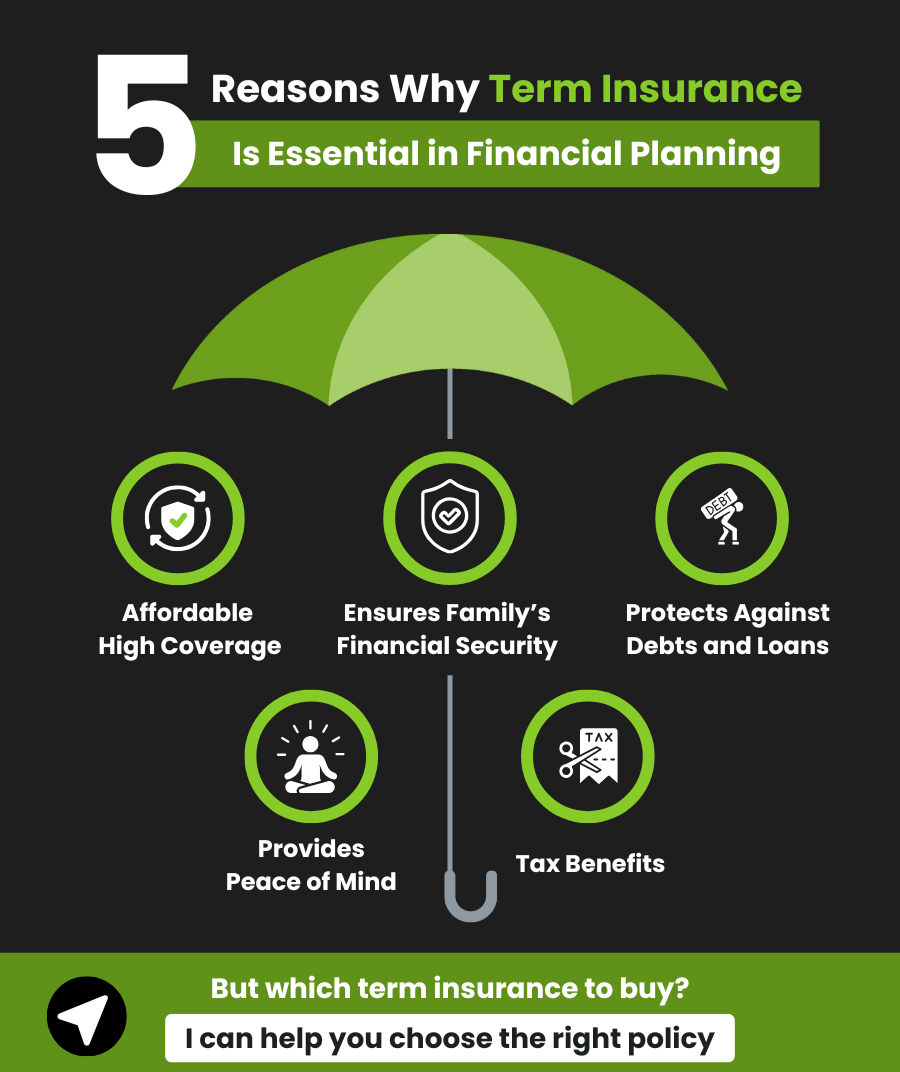
Term insurance is available in several structures. The exact features vary among insurers and products.
1. Level Term Insurance
A level-term insurance policy provides a predetermined sum assured throughout the policy term. For example, if a policy provides a specified life cover for a particular period, the applicable death benefit generally remains at that level throughout the term, subject to policy conditions.
Key Features
- Fixed policy term
- Predetermined life cover
- Primarily protection-oriented
- Generally straightforward to understand
- Premium depends on factors such as age, health, coverage, term, and underwriting
Level term insurance is one of the simplest forms of term protection.
2. Increasing Term Insurance
An increasing-term insurance policy is structured so that the life cover increases according to the product’s specified schedule or formula. This type of structure may be considered where an individual wants coverage to increase over time, potentially helping address the effect of inflation and increasing financial responsibilities.
The exact increase, maximum cover, premium structure, and other conditions vary by product. Before purchasing, policyholders should understand whether the premium remains fixed and how the sum assured changes over time.
3. Decreasing Term Insurance
In a decreasing-term policy, the life cover reduces over the policy term according to a predetermined schedule.
This structure can sometimes be considered in relation to liabilities that are expected to decline over time, although the suitability depends on the individual’s circumstances and the specific policy.
4. Return of Premium Term Insurance
Some term-insurance products offer a return-of-premium feature. Under such a structure, if the insured person survives the policy term, the policy may return specified premiums according to the product’s terms and conditions.
The premium for such a product may be higher than that of a comparable pure-term policy. Therefore, individuals should compare:
- Total premiums paid
- Death benefit
- Maturity benefit
- Policy duration
- Liquidity
- Other conditions
The decision should be based on overall suitability rather than simply expecting a premium refund.
5. Convertible Term Insurance
Some term policies may offer a conversion facility that allows the policyholder to convert the term cover into another eligible life-insurance product, subject to specified conditions.
This can provide flexibility if the individual’s financial requirements change over time. However, conversion provisions differ among products and may have specific deadlines, limits, underwriting requirements, or other conditions.
6. Term Insurance with Riders
Term-insurance policies may offer optional riders that provide additional benefits for specified events. Depending on the insurer and policy, riders may include:
- Accidental death benefit
- Critical illness-related benefit
- Disability-related benefit
- Waiver of premium
- Other specialized protection
Riders come at an additional cost and should be selected only when they address a genuine financial risk. More riders do not automatically mean better protection.
Term Insurance Cover Amount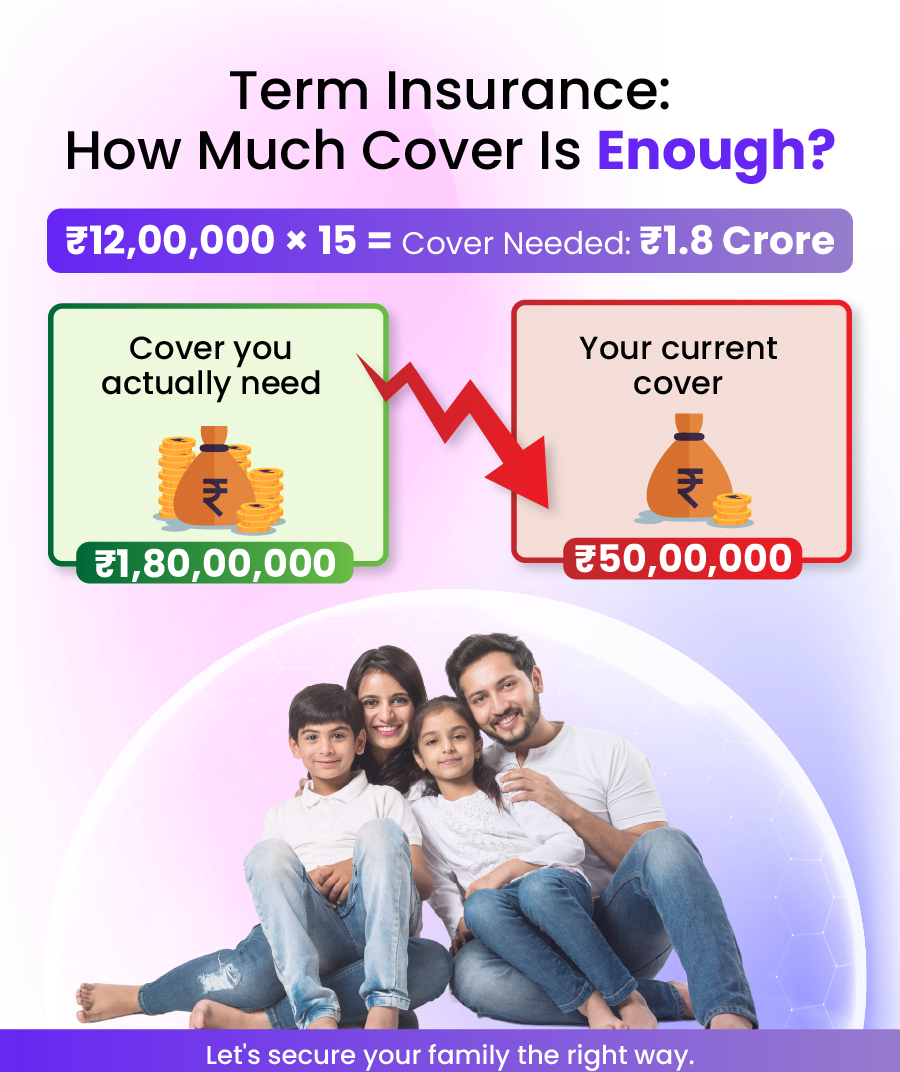
There is no universal amount of term insurance suitable for everyone. A proper assessment should consider:
- Current Income – The policyholder’s earning capacity is an important factor in determining the financial protection required.
- Number of Dependents – A person supporting a spouse, children, parents, or other dependents may require greater coverage.
- Outstanding Loans – Home loans and other significant liabilities should be considered.
- Children’s Future Goals – Education and other long-term responsibilities should be incorporated into the calculation.
- Existing Assets – Savings, investments, property, and other financial resources may reduce the additional insurance requirement.
- Inflation – Future household expenses are likely to be different from today’s expenses.
- Retirement Needs – The financial plan should also consider the spouse’s and family’s future retirement requirements where relevant.
A financial planner or insurance advisor can help evaluate these factors and estimate an appropriate protection requirement.
Term Insurance Premiums
The premium for term insurance varies from person to person. Important factors may include:
- Age – Age is an important underwriting factor. Premiums may generally be lower when coverage is purchased at a younger age, subject to eligibility and underwriting.
- Health – Medical history and current health conditions can influence underwriting and premium rates.
- Sum Assured – Higher life cover generally results in a higher premium.
- Policy Term – The duration of coverage can affect the premium.
- Lifestyle – Certain lifestyle factors can influence the insurer’s assessment of risk.
- Occupation – Some occupations involve higher levels of risk and may affect underwriting.
- Smoking and Tobacco Use – Tobacco use can significantly influence life-insurance underwriting and premiums.
Applicants should always disclose information accurately and completely.
Term Insurance: Benifits of Early Planning
Purchasing life insurance earlier may offer several potential advantages, subject to eligibility and underwriting.
- Longer Protection Period – Younger individuals may have many years of financial responsibilities ahead.
- Potentially Lower Premium – Age is one factor used in premium calculation, so purchasing earlier may result in a different premium than purchasing later.
- Financial Discipline – Obtaining adequate protection early can help secure long-term financial responsibilities.
- Protection Before Major Liabilities – Term insurance can be particularly relevant before taking on substantial responsibilities such as a home loan or starting a family.
However, the right timing depends on individual circumstances and financial responsibilities.
Term Insurance vs Investment
It is important to understand that insurance and investment have different objectives.
- Insurance protects.
- Investments aim to create or grow wealth.
Trying to use a single product for every financial objective may not always produce the most efficient strategy. A comprehensive financial plan may therefore use term insurance for protection and appropriate investment products for wealth creation.
This approach can make the financial plan easier to understand and evaluate.
Insurance Advisor
An insurance advisor can help individuals understand their life-protection requirements and evaluate suitable term-insurance options.
The advisor may assist with:
- Assessing financial responsibilities
- Estimating insurance requirements
- Comparing policy features
- Explaining premium structures
- Understanding riders
- Reviewing exclusions
- Understanding claim procedures
- Reviewing existing coverage
The advisor should focus on needs-based protection, not simply selling the highest-cover policy or the most expensive product.
Conclusion
Term insurance is fundamentally about protecting income, family responsibilities, and financial goals. It can provide substantial life cover for a comparatively affordable premium and can play an important role in a comprehensive financial plan.
The major types include level-term insurance, increasing-term insurance, decreasing-term insurance, return-of-premium term insurance, convertible term insurance, and term insurance with optional riders, depending on the products available from insurers.
The right policy is not necessarily the one with the lowest premium or the highest coverage. It is the one that provides appropriate protection for the right duration at a cost that fits the policyholder’s financial plan.
Families should consider their income, dependents, liabilities, children’s future needs, existing assets, inflation, and long-term financial objectives when determining their insurance requirement.
Most importantly, term insurance should be viewed primarily as a protection product—not a substitute for investment planning.
Protect Your Income. Secure Your Family. Safeguard Your Financial Goals.
Disclaimer: This article is intended for general educational and awareness purposes only. It does not constitute personalized insurance, investment, tax, legal, or financial advice. Policy features, benefits, premiums, exclusions, underwriting requirements, claim conditions, and availability vary by insurer and product and are subject to the applicable policy documents and prevailing laws and regulations. Prospective policyholders should carefully read the policy wording and consult an appropriately authorized insurance professional before purchasing a policy.
— Admin —
1 Comment