


Financial Planning & Goals:
Financial goals are the foundation of successful financial planning. Earning money is important, but knowing how to allocate, save, invest, and protect that money according to clearly defined objectives is equally important. Without specific goals, people may save irregularly, invest without direction, spend excessively, or postpone important financial decisions.
Financial goal setting provides a roadmap that connects today’s income and financial decisions with tomorrow’s dreams and responsibilities. Whether the objective is buying a house, funding children’s education, creating an emergency fund, becoming debt-free, building wealth, or achieving a financially independent retirement, clearly defined goals can make financial decisions more purposeful.
A well-designed financial goal should be realistic, measurable, time-bound, and aligned with an individual’s income, responsibilities, risk tolerance, and overall financial situation.
Financial Planning: Importance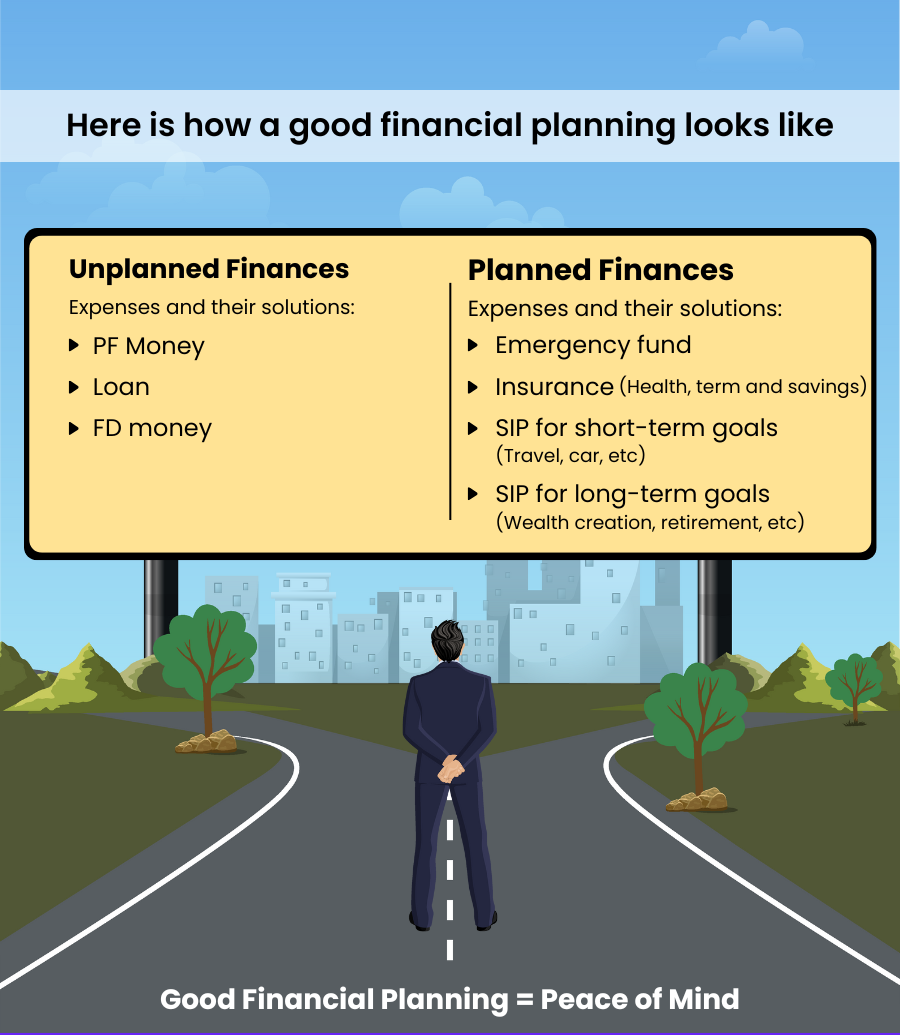
A good Financial Planning provides:
- Provides Financial Direction – Without a plan, people may save and invest without knowing whether their actions are sufficient to achieve their goals. Financial planning provides a clear direction by connecting available resources with specific objectives.
- For example, instead of simply saying, “I want to save money,” a financial plan can establish a target for children’s education, retirement, emergency savings, or another financial goal.
- Helps to Achieve Financial Goals – Most people have multiple financial goals. Financial planning helps prioritize these goals according to their importance, time horizon, and financial feasibility. These may include:
- Buying a house
- Purchasing a vehicle
- Children’s education
- Starting a business
- International education
- Retirement
- Family protection
- Wealth creation
- Encourages Regular Savings – A financial plan can transform saving from an occasional activity into a disciplined habit.
- Regular savings and investments can help individuals gradually build resources for future needs.
- The earlier disciplined saving begins, the more time there may be for accumulated investments to potentially grow through compounding, depending on the investment chosen.
- Helps Manage Financial Risks – Financial uncertainty is unavoidable. Unexpected events such as illness, accidents, loss of income, or other emergencies can affect a family’s financial position. Financial planning therefore includes appropriate risk-management tools such as:
- Emergency funds
- Health insurance
- Life insurance
- Personal accident protection
- Appropriate asset diversification
- Supports Wealth Creation – Saving alone may not always be sufficient to achieve long-term financial goals. Depending on the investor’s circumstances, suitable investment products can potentially help grow wealth over time. Investment choices should consider:
- Risk tolerance
- Investment horizon
- Financial objectives
- Liquidity requirements
- Tax considerations
- Market conditions
What Is Financial Goal Setting?
Financial goal setting is the process of identifying specific financial objectives and determining how much money is required, when it will be needed, and how it can be accumulated. Instead of having a general objective such as “I want to become financially secure,” goal setting converts that intention into measurable targets.
For example:
- Build an emergency fund within a specified period.
- Save for a child’s higher education.
- Purchase a home after accumulating the required down payment.
- Repay a high-cost loan within a planned timeframe.
- Build a retirement corpus before retirement.
- Create a long-term wealth portfolio.
A financial goal should answer four fundamental questions:
- What do I want to achieve?
- How much money will I need?
- When will I need it?
- How will I fund it?
These questions create the foundation of a practical financial plan.
Financial Goal Setting: Importance
Financial goal setting has following importances –
- Gives Your Money a Purpose – Money without a purpose can easily be spent without creating long-term value. Financial goals give every rupee a specific purpose. When individuals know why they are saving or investing, they may find it easier to maintain financial discipline.
- For example, saving for a child’s education creates a clear purpose, while “saving more money” is a much less specific objective.
- Helps Prioritize Financial Decisions – Most individuals have multiple financial objectives. You may want to –
- Buy a house
- Purchase a vehicle
- Travel
- Fund education
- Start a business
- Build wealth
- Retire comfortably
- Encourages Disciplined Saving – Once a goal has a defined amount and deadline, it becomes easier to establish a regular savings or investment strategy. For example, instead of saving whatever amount remains at the end of each month, an individual can allocate a predetermined amount toward specific goals. This transforms saving from a leftover activity into a planned financial habit.
- Helps Select Appropriate Investments – Different financial goals have different time horizons. Money required in the near future should generally be managed differently from money intended for a goal several decades away. For example:
- Short-term goals may prioritize liquidity and capital stability.
- Medium-term goals may use a balanced approach depending on risk tolerance.
- Long-term goals may have greater capacity to consider growth-oriented investments.
- Helps Manage Financial Stress – Unplanned financial responsibilities can create significant stress. Goal setting provides greater clarity about future requirements and encourages preparation in advance. Knowing that money is being systematically accumulated for education, retirement, emergencies, or other major expenses can provide greater financial confidence.
Financial Goals: Types
Financial goals can generally be divided according to their time horizon. These are –
- Short-Term Goals – These are goals expected to be achieved within a relatively short period. The focus is generally on liquidity, safety, and accessibility. Examples include –
- Building an emergency fund
- Paying an annual insurance premium
- Buying essential household equipment
- Planning a short-term expense
- Repaying certain high-cost debts
- Medium-Term Goals – These goals may require several years of preparation. The investment approach should consider the time available and the investor’s ability to tolerate fluctuations. Examples include –
- Buying a vehicle
- Making a house down payment
- Funding higher education
- Starting a business
- Major family expenses
- Long-Term Goals – Long-term goals may have a horizon extending over many years. These goals provide greater time for systematic investment and potentially benefit from the power of compounding, although investment returns are never guaranteed. Examples include –
- Retirement
- Children’s future education
- Long-term wealth creation
- Estate planning
- Financial independence
Approach to Financial Goals
One useful framework for setting goals is the S-M-A-R-T approach. It means –
- S – “Specific” – The goal should clearly identify what you want to achieve. Set a specific objective such as – “I want to build a dedicated education fund.”
- M – “Measurable” – Assign a financial target to the goal.
- A – “Achievable”– The target should be realistic considering income, expenses, and other responsibilities.
- R – “Relevant” – The goal should be meaningful and aligned with your broader financial priorities.
- T – “Time-Bound” – Every major financial goal should have a target date.
A goal becomes much more actionable when it is specific, measurable, achievable, relevant, and time-bound.
Goal Setting Strategies:
Strategy 1: Identify Your Life Goals
Financial goals should begin with life goals. Ask yourself –
- Where do I want to live?
- What kind of lifestyle do I want?
- Do I want to purchase a home?
- What education do I want to provide for my children?
- When do I want to retire?
- What financial support may my family require?
- What legacy do I want to leave?
Financial planning should support life decisions rather than becoming an exercise in accumulating money without purpose.
Strategy 2: Calculate Your Current Financial Position
Before setting financial targets, understand where you currently stand. Prepare a simple financial statement covering –
- Assets – These include –
- Bank balances
- Investments
- Property
- Retirement savings
- Other financial assets
- Liabilities – These include –
- Home loans
- Vehicle loans
- Personal loans
- Credit-card balances
- Other obligations
- Income – Calculate your regular income.
- Expenses – Track household and discretionary expenses.
This provides a realistic starting point for financial goal setting.
Strategy 3: Prioritize Your Goals
Not all goals have equal importance and priorities. A useful priority structure can be – Essential → Important → Aspirational
- Essential goals may include emergency savings, adequate insurance, debt management, and basic family responsibilities.
- Important goals may include children’s education, home purchase, and retirement.
- Aspirational goals may include luxury purchases, extensive travel, or other discretionary objectives.
Prioritization ensures that essential financial protection is not sacrificed for short-term lifestyle spending.
Strategy 4: Assign a Financial Value to Every Goal
A goal without a financial target is difficult to plan for. Estimate the amount required for each objective. For example –
- Goal: Children’s higher education
- Target Year: Future year
- Estimated Cost: Calculated based on today’s cost and expected inflation
Similarly, retirement planning should estimate the amount required to maintain the desired lifestyle after regular employment income stops.
Strategy 5: Consider Inflation
One of the most important elements of long-term goal planning is inflation.
- The cost of goods and services generally changes over time. Therefore, a financial target based only on today’s cost may underestimate the amount required in the future. For example, an education expense that appears affordable today may require substantially more funding many years from now.
- Financial goals should therefore consider the potential effect of inflation when estimating future requirements.
Strategy 6: Match Investments to the Goal’s Time Horizon
Investment strategy should be aligned with the goal.
- For short-term goals, protecting capital and maintaining liquidity may be more important than pursuing aggressive growth.
- For long-term goals, investors may have greater capacity to consider assets with higher volatility and growth potential, depending on their risk tolerance.
The important principle is: Goal First → Time Horizon Second → Risk Assessment Third → Investment Selection Fourth
Strategy 7: Create Separate Goal-Based Investments
One practical strategy is to mentally or operationally separate investments according to their objectives. For example:
- Emergency Fund
- Education Fund
- Home Fund
- Retirement Fund
- Wealth-Creation Portfolio
This approach can make it easier to monitor progress and avoid using money intended for one goal for unrelated expenses.
Strategy 8: Automate Savings and Investments
Automation can improve financial discipline. Individuals can arrange regular transfers or systematic investments shortly after receiving income.
- The principle is simple: Pay Yourself First.
Instead of spending first and saving whatever remains, allocate the planned savings amount first and manage the remaining income accordingly. Automation reduces the need to make the same financial decision every month.
Strategy 9: Build an Emergency Fund First
Before pursuing aggressive long-term investment goals, establish an appropriate emergency reserve. The appropriate amount of fund depends on income stability, household expenses, dependents, and individual circumstances.
- An emergency fund can help manage unexpected expenses without forcing individuals to sell long-term investments at an inconvenient time or rely excessively on borrowing.
Strategy 10: Protect Your Goals with Insurance
Financial goals can be disrupted by unexpected events related to life and health. Appropriate insurance can help protect the financial plan.
- Health Insurance – Can help manage eligible healthcare expenses according to policy conditions.
- Life Insurance – Can provide financial protection for dependents against the financial impact of the insured person’s death.
- Personal Accident Insurance – Can provide specified benefits for covered accidental events.
Insurance should be selected based on actual risks and financial responsibilities rather than simply for tax-saving purposes.
Strategy 11: Manage Debt Alongside Goals
Debt repayment should be integrated into financial goal planning. High-cost debt can significantly reduce the amount available for savings and investments. A practical strategy may include:
- Prioritizing expensive debt
- Making timely repayments
- Avoiding unnecessary borrowing
- Maintaining a manageable debt burden
- Balancing debt repayment with essential savings and protection
Becoming financially stronger often requires both building assets and controlling liabilities.
Strategy 12: Use the Power of Compounding
Long-term financial goals can potentially benefit from compounding. When investment returns are reinvested, future growth can occur on both the original investment and previously accumulated returns. However, compounding does not guarantee investment returns. The actual outcome depends on the investment product and market performance. The key advantage of starting early is the time available for potential growth.
Strategy 13: Increase Savings as Income Grows
As income increases, savings should ideally increase as well. Instead of allowing lifestyle expenses to consume every salary increase, allocate a portion of additional income toward financial goals. This strategy can help prevent excessive lifestyle inflation. For example, whenever income rises, consider increasing regular investments before significantly increasing discretionary spending.
Strategy 14: Review Your Goals Regularly
Financial goals are not permanent. A goal that was appropriate five years ago may no longer be relevant today. Therefore, financial planning should include regular reviews. Your circumstances may change due to –
- Marriage
- Birth of a child
- Career advancement
- Job change
- Business growth
- Home purchase
- Major debt
- Changes in family responsibilities
- Approaching retirement
Strategy 15: Track Progress
A financial goal becomes more effective when progress is measurable. Reviewing progress periodically can help identify whether savings or investment contributions need any adjustment. Create a simple tracking system showing:
| Goal | Target Amount | Target Date | Current Progress |
|---|---|---|---|
| Emergency Fund | Defined target | Planned date | Amount accumulated |
| Child Education | Estimated future cost | Target year | Current corpus |
| Home Purchase | Required down payment | Target year | Savings accumulated |
| Retirement | Required corpus | Retirement age | Current investments |
Role of Financial Planner in Goal Setting
A financial planner can help convert broad ambitions into structured financial objectives. The role is not simply to recommend investment products. A good financial-planning process starts with understanding the individual’s goals and financial circumstances and then determining an appropriate strategy. A professional may assist with:
- Financial assessment
- Goal identification
- Goal prioritization
- Cash-flow analysis
- Risk assessment
- Insurance planning
- Investment allocation
- Retirement planning
- Portfolio review
- Progress monitoring
Financial Goal-Setting Process
A simple seven-step framework in goal setting can help –
- Step 1 — Identify: Write down your financial and life goals.
- Step 2 — Quantify: Estimate the amount required for each goal.
- Step 3 — Time Horizon: Determine when the money will be needed.
- Step 4 — Prioritize: Rank goals according to importance.
- Step 5 — Protect: Establish emergency savings and appropriate insurance.
- Step 6 — Invest: Choose suitable investments based on time horizon and risk tolerance.
- Step 7 — Review: Monitor progress and make adjustments when circumstances change.
This creates a continuous cycle: Set → Save → Invest → Monitor → Review → Adjust
Conclusion
Financial goal setting is the bridge between financial dreams and financial achievement. Without clearly defined objectives, saving and investing can become directionless activities.
- With proper goals, every financial decision can have a purpose.
- Successful financial goal setting requires understanding current financial position, estimating future requirements, considering inflation, prioritizing objectives, managing risks, selecting suitable investments, controlling debt, and reviewing progress regularly.
- Whether your goal is building an emergency fund, purchasing a home, funding children’s education, creating wealth, becoming debt-free, or achieving a financially independent retirement, starting early and following a disciplined strategy can make the journey more manageable.
Remember that financial planning is about preparing for the future with a clear strategy and adapting when circumstances change.
Define Your Goals. Plan Your Money. Invest with Purpose. Protect Your Future. Achieve Financial Freedom.
Disclaimer: This article is intended for general educational and awareness purposes only. It does not constitute personalized financial, investment, insurance, tax, or legal advice. Investment products are subject to market risks, and returns are not guaranteed unless specifically stated by the product. Financial strategies should be based on individual circumstances, objectives, risk tolerance, time horizon, and applicable laws and regulations. Readers should consult appropriately qualified and authorized professionals before making financial decisions.
— Admin —
1 Comment