

Retirement Planning:
Retirement is one of the most important financial goals for which planning should begin early. During working years, regular income generally supports household expenses, lifestyle, children’s education, housing, and other responsibilities. After retirement, however, employment income may reduce or stop while many expenses continue.
Retirement planning is the process of estimating future financial requirements and creating a strategy to accumulate sufficient resources to support life after employment. A well-designed retirement plan should address income replacement, inflation, healthcare costs, longevity, investment risk, taxation, liquidity, and wealth transfer.
The earlier retirement planning begins, the greater the opportunity to build a retirement corpus through disciplined saving and long-term investing.
What Is Retirement Planning?
Retirement planning is a structured process of determining the answers of following:
- When you want to retire?
- How much income you may require after retirement?
- How much retirement corpus may be required?
- How much should be saved and invested today?
- Which investment avenues may be appropriate?
- How healthcare and emergencies will be managed?
- How retirement income will be generated?
- How assets will be protected and transferred?
Retirement planning should not be based only on the amount of money currently available. It should consider the future value of today’s expenses, expected inflation, investment returns, retirement duration, and changing lifestyle requirements.
Importance of Retirement Planning:
Retirement planning is important for the following reasons: –
1. Employment Income May Stop
One of the biggest financial changes during retirement is the potential loss of regular employment income. Salary provides predictable cash flow during working years. After retirement, income may need to come from:
- Pension
- Annuity income
- Interest income
- Dividends, where applicable
- Rental income
- Systematic Withdrawal Plans
- Other accumulated financial assets
Building these income sources requires preparation during working years.
2. Retirement Life Can Last for Many Years
People may spend several decades in retirement. If someone retires at 60 and lives well into their 80s or 90s, retirement savings may need to support expenses for 20–30 years or more. Therefore, retirement planning must account for longevity risk—the possibility of living longer than expected.
Retirement should not be planned merely around average life expectancy.
3. Inflation Can Significantly Increase Expenses
Inflation is one of the most important retirement-planning risks. The cost of food, housing, healthcare, transportation, and other services can rise over time. For example, an expense that appears manageable today may require substantially more money several decades later.
Therefore, retirement planning should estimate future expenses rather than simply multiplying today’s monthly expenses by the number of retirement years.
4. Healthcare Costs May Increase
Healthcare is an important retirement consideration. As people age, medical expenses may become more significant. A retirement plan should therefore consider:
- Health insurance
- Medical emergency funds
- Regular healthcare expenses
- Potential long-term care requirements
Adequate health insurance can help manage eligible medical expenses according to policy terms. However, insurance should be viewed as a risk-management tool rather than a complete substitute for retirement savings.
5. Dependence on Children May Not Be Practical
Traditionally, some retirees have depended on their children for financial support. However, changing lifestyles, employment patterns, geographical mobility, and increasing living costs mean that individuals may prefer to achieve greater financial independence.
A properly constructed retirement corpus can provide greater financial autonomy.
6. Retirement Goals Extend Beyond Basic Expenses
Retirement is not necessarily limited to meeting food and household expenses. Retirees may also want to:
- Travel
- Pursue hobbies
- Support family members
- Donate to causes
- Maintain a preferred lifestyle
- Purchase gifts for grandchildren
- Start a small venture
These objectives should be incorporated into retirement planning where financially feasible.
Retirement Corpus:
There is no universal retirement corpus applicable to everyone. The required amount depends on factors such as:
- Current age
- Expected retirement age
- Current income
- Current expenses
- Expected inflation
- Investment returns
- Desired retirement lifestyle
- Existing investments
- Pension or other income
- Healthcare requirements
- Expected retirement duration
A financial planner can use these factors to develop a personalized retirement estimate. The key principle is:
Retirement planning should be based on future cash-flow requirements rather than an arbitrary corpus number.
Importance of Early Planning
Time is one of the most valuable resources in retirement planning. Starting early allows investments more time to potentially compound. For example, someone who begins systematic investing in their 20s or early 30s may have several decades for their retirement investments to grow.
Someone starting much later may need significantly higher contributions to target a similar retirement corpus. This does not mean younger investors should take excessive risk. Instead, it highlights the value of early planning and disciplined investing.
Investment for Retirement Planning
Different investment products can serve different roles in a retirement portfolio. The appropriate combination depends on the investor’s financial situation, risk profile, time horizon, and retirement objectives. These include:
- Employee Provident Fund (EPF) – For eligible salaried employees, EPF can be an important retirement-oriented savings mechanism. It encourages systematic contributions during employment and can form part of the retirement corpus.
- Public Provident Fund (PPF) – It is a government-backed long-term savings scheme with defined rules regarding contributions, interest, maturity, withdrawals, and taxation.
- National Pension System (NPS) – NPS is a regulated retirement-oriented investment system that allows individuals to build retirement savings through contributions during their working years.
- Mutual Funds – Mutual funds can play an important role in long-term retirement planning. Depending on the investor’s risk profile and time horizon, retirement portfolios may use different categories of mutual funds.
- Equity Investments – Equities can play an important role in long-term retirement wealth creation for investors who have sufficient time horizon and risk capacity.
- Bonds and Debt Instruments – Bonds and other debt instruments can provide income-oriented exposure and may help diversify a retirement portfolio.
- Bank Fixed Deposits – Bank fixed deposits can provide relatively predictable interest according to applicable terms.
- Senior Citizens’ Savings Scheme (SCSS) – It is designed specifically for eligible senior citizens and provides an interest-based savings avenue under government rules. It can potentially form part of the income-oriented component of a retirement portfolio.
- Annuities – An annuity can provide a structured stream of income in exchange for an investment according to the product’s terms.
- Real Estate – Real estate may form part of some retirement strategies.
- Gold and Other Diversifiers – Gold may sometimes be included as a diversification asset.
Asset Allocation in Retirement Planning
Asset allocation is one of the most important components of retirement investing.
- During the accumulation phase, investors with a long horizon may have greater capacity to hold growth-oriented investments with higher exposure in equity oriented schemes.
- As retirement approaches, the portfolio may require periodic review to ensure that the level of volatility and liquidity is appropriate for the investor’s changing needs. At this time more exposure leans to secured investment and less in volatile equity schemes.
There is no universally correct equity/debt ratio. The appropriate allocation depends on: Age + Retirement Horizon + Risk Capacity + Risk Tolerance + Existing Corpus + Income Requirements
Diversification
A retirement portfolio should generally avoid excessive dependence on one investment. Diversification can be achieved by investing across:
- Equity
- Debt
- Government securities
- Bank deposits
- Mutual funds
- Other appropriate assets
Diversification may reduce concentration risk, but it does not guarantee profits or prevent losses.
Retirement Income Planning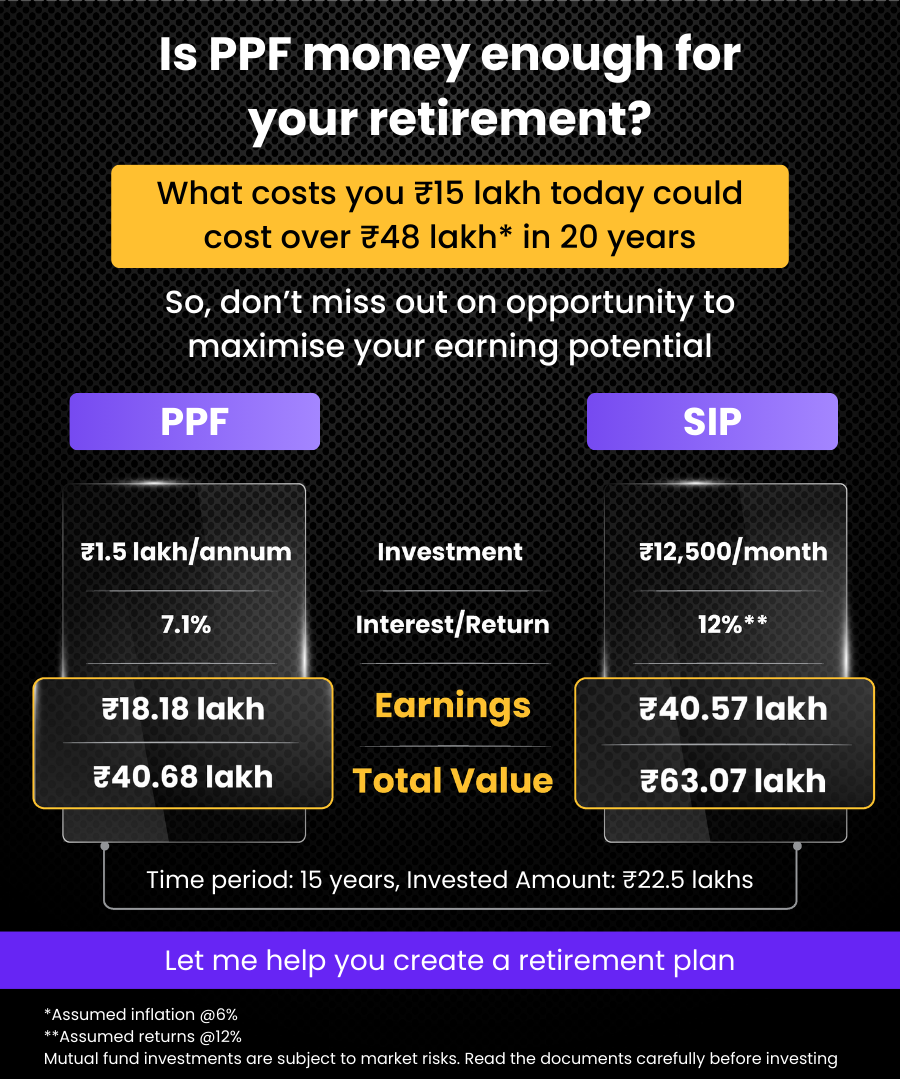
Accumulating a retirement corpus is only one side of retirement planning. The second side is determining how the corpus will generate sustainable income.
Potential retirement income sources may include:
- Pension
- Annuity
- Interest
- Rental income
- Dividends, where applicable
- Systematic withdrawals
- Government-supported savings schemes
- Other financial assets
The withdrawal strategy should consider:
- Inflation
- Market conditions
- Life expectancy
- Healthcare expenses
- Taxation
- Remaining corpus
Sequence-of-Returns Risk
One important risk during retirement is sequence-of-returns risk. If a portfolio experiences significant negative returns early in retirement while the investor is simultaneously withdrawing money, the long-term sustainability of the portfolio may be affected.
Therefore, retirement planning should consider not only average investment returns but also the timing of market gains and losses. Maintaining an appropriate liquidity reserve and diversified portfolio can help manage this risk.
Retirement Planning Framework
A simple retirement-planning process can follow these steps:
- Step 1 — Define Retirement Age – Determine the approximate age at which you want financial independence from employment.
- Step 2 — Estimate Retirement Expenses – Estimate your expected lifestyle and essential expenses.
- Step 3 — Account for Inflation – Project today’s expenses into the future.
- Step 4 — Estimate Retirement Corpus – Calculate the approximate corpus required to support the expected retirement period.
- Step 5 — Review Existing Resources – Consider EPF, PPF, NPS, mutual funds, deposits, property, pension, and other assets.
- Step 6 — Determine the Savings Requirement – Establish the amount that needs to be invested regularly.
- Step 7 — Select Appropriate Investments – Match investment risk and return potential with the retirement horizon.
- Step 8 — Protect the Plan – Maintain suitable health insurance and emergency reserves.
- Step 9 — Review Regularly – Adjust contributions and asset allocation as income, markets, and circumstances change.
- Step 10 — Create a Retirement Income Strategy – Determine how the accumulated corpus will support expenses after retirement.
Role of a Financial Planner
A financial planner can help convert retirement goals into a structured financial strategy. A professional may assist with:
- Retirement corpus estimation
- Cash-flow analysis
- Inflation calculations
- Investment planning
- Asset allocation
- Risk assessment
- Insurance planning
- Portfolio monitoring
- Retirement income planning
- Estate and succession planning
The objective is to create a retirement strategy based on the individual’s actual financial circumstances rather than using a one-size-fits-all approach.
Conclusion
- Retirement planning should begin as early as possible because retirement is one of the longest and most financially important goals of life.
- A successful retirement strategy requires more than simply accumulating money. It requires planning for inflation, healthcare, longevity, investment risk, liquidity, taxation, income generation, and changing financial needs.
- Investment avenues such as EPF, PPF, NPS, mutual funds, SIPs, equity, bonds, fixed deposits, SCSS, annuities, real estate, and gold can serve different roles within a retirement strategy. However, no single investment is suitable for every investor.
- Starting early, saving consistently, investing appropriately, protecting against major risks, and reviewing the plan regularly can significantly improve financial preparedness for retirement.
- The ultimate objective is not merely to retire from employment. It is to achieve financial independence and maintain dignity, choice, and confidence throughout the retirement years.
The right approach is to build a diversified strategy based on:
Retirement Goal → Time Horizon → Required Corpus → Risk Profile → Asset Allocation → Regular Investment → Periodic Review → Retirement Income Strategy
Start Early. Invest Regularly. Protect Your Corpus. Plan Your Income. Retire with Confidence.
Disclaimer: This article is intended for general educational and awareness purposes only and does not constitute personalized financial, investment, insurance, tax, or legal advice. Investment products are subject to market risks, and returns are not guaranteed unless specifically stated by the product. Tax rules, interest rates, eligibility criteria, withdrawal conditions, and government-scheme provisions may change from time to time. Investors should verify the prevailing rules and consult appropriately qualified and authorized professionals before making financial or retirement-planning decisions.
— Admin —