Human Psychology
Understanding Wealth & Health Management
Human beings make countless decisions every day about money, health, family, work, lifestyle, and the future. Although these decisions may appear logical, they are often strongly influenced by emotions, habits, beliefs, social influence, and psychological biases.
Wealth management and health management have something important in common: both require long-term thinking, discipline, consistency, risk management, and the ability to make sensible decisions even when immediate emotions encourage otherwise.
Understanding human psychology can therefore help individuals develop better financial and health-management habits.
Preference for Immediate Rewards:

People naturally tend to value immediate benefits more than future benefits. This psychological tendency can influence both financial and health decisions.
Spending money today can provide immediate satisfaction, while saving and investing may provide benefits much later. Similarly, watching television or using a phone may feel easier in the short term than maintaining healthy daily habits.
A useful approach is to balance present enjoyment with future responsibilities rather than completely sacrificing one for the other.
Procrastination:
 One of the most common psychological barriers is procrastination.
People may postpone starting an investment plan because they believe their income is currently insufficient. Similarly, they may postpone improving their lifestyle because they believe they will start “next month.” Repeated postponement can become a habit.
In wealth management, starting financial planning early can provide more time to work toward long-term goals. In health management, developing sustainable healthy habits early can also support long-term well-being.
The important principle is simple: Do not wait for perfect circumstances to begin making reasonable improvements.
Fear and Uncertainty:
 Fear strongly influences human decision-making.
In financial markets, fear may cause investors to react emotionally to market declines. Some investors may make decisions based primarily on short-term market movements rather than their original financial objectives.
Health decisions can also be influenced by fear. A person may worry excessively about a particular health issue or, conversely, avoid dealing with an important concern because they are afraid of the possible outcome. In both areas, informed decision-making is generally more useful than emotional reactions.
Financial decisions should be based on goals, risk tolerance, time horizon, and reliable information. Health decisions should similarly be based on appropriate information and professional medical guidance when necessary.
Overconfidence:
 Another important psychological factor is overconfidence.
An investor may believe they can consistently predict market movements or select winning investments without adequately considering risk. This can lead to excessive concentration or unnecessary risk-taking.
In health management, a person may similarly believe that poor habits will not affect them because they have experienced no immediate consequences.
The lesson is that confidence should be accompanied by awareness of limitations and appropriate risk management.
Social Influence:
 Human beings naturally compare themselves with others.
Financially, people may compare their homes, cars, lifestyles, investments, or spending habits with friends and relatives. This can encourage unnecessary consumption or investment decisions based on social pressure rather than personal financial objectives.
Social comparison can also influence health-related behaviour. People may adopt trends or routines simply because others are following them.
A healthier approach is to recognise that every individual has different circumstances.
Your financial plan and health plan should be appropriate for your own situation rather than designed around someone else’s lifestyle.
Spending Psychology:
 Spending money is not always a purely mathematical decision.
Emotional states can influence purchasing behaviour. Stress, excitement, boredom, social pressure, and the desire for instant gratification may encourage unnecessary spending.
This does not mean that every expense is bad. Money should also be used to enjoy life and meet genuine needs.
The objective of financial planning is not to eliminate spending but to create a balance between present needs, lifestyle choices, savings, protection, and future goals.
A simple budget can help individuals become more conscious of where their money is going.
Saving and Investing:
 Saving requires the ability to delay some present consumption for future objectives.
Simply knowing that saving is important does not always create action. Systems and habits are often more effective than relying entirely on motivation.
For example, setting up a regular investment or savings process can help create financial discipline.
Investment decisions should nevertheless be made after considering financial goals, risk tolerance, liquidity requirements, time horizon, and the characteristics of the investment product.
Wealth and Health:
 There is an interesting psychological connection between wealth management and health management.
Both require: (1) Setting realistic goals (2) Developing sustainable habits (3) Managing risks (4) Avoiding extreme decisions (5) Monitoring progress (6) Making adjustments when circumstances change (7) Thinking about long-term consequences
For example, financial security can be affected by inadequate emergency savings or insufficient insurance protection. Similarly, health and financial well-being can both be affected when people consistently ignore preventive measures.
The broader lesson is that prevention is often an important part of good management.
Decision Making:
 Financial uncertainty can create stress, while health concerns can also affect emotional well-being. Stress may sometimes make people more likely to make impulsive decisions.
A structured financial plan can provide clarity about income, expenses, emergency reserves, insurance, investments, and long-term goals.
Similarly, maintaining sensible health routines and seeking appropriate professional guidance can help people approach health-related decisions more systematically.
Neither financial planning nor health management can eliminate uncertainty, but both can help individuals prepare for foreseeable risks and respond more thoughtfully to changing circumstances.
Long-Term Mindset:
 Perhaps the most important psychological principle is understanding the value of consistency over perfection.
A person does not need to make every financial or health decision perfectly. Instead, sustainable habits followed over time can make a meaningful difference.
In wealth management, regular saving, appropriate investing, insurance protection, periodic reviews, and disciplined spending can contribute to a structured financial life.
In health management, appropriate nutrition, physical activity, adequate rest, preventive care, and professional medical attention when required can support overall well-being.
The objective in both cases should be sustainable progress rather than unrealistic perfection.
Financial Planner:
 A financial planner can help bring structure to financial decision-making by looking beyond individual investment products.
A comprehensive approach may consider: (1) Current income and expenses (2) Financial goals & Time Line (3) Insurance and risk protection (4) Investment strategy & Retirement planning (5) Tax considerations & Liabilities (6) Family responsibilities (7) Periodic review of the financial plan
The planner’s role is not simply to discuss investments but to help the individual understand how different financial decisions fit together.
Conclusion:
Human psychology has a powerful influence on both wealth management and health management. Fear, procrastination, overconfidence, social comparison, emotional decision-making, and the desire for immediate rewards can affect the choices people make.
Wealth and health are both long-term assets. They require awareness, planning, protection, discipline, and regular attention.
A balanced approach to life therefore involves not only asking, “How much wealth can I create?” but also asking, “How can I manage my wealth responsibly while protecting my health and overall quality of life?”
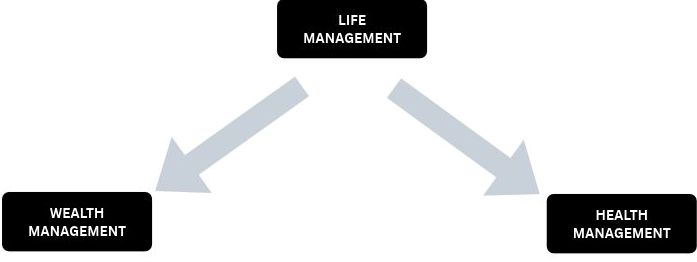
Ultimately, human life continuously struggle in balancing between the two long term goals: WEALTH MANAGEMENT & HEALTH MANAGEMENT